
Arenac County Arrest Records and Court Charges
An arrest record is the account of the arrest itself. It notes who made the arrest, the date, and the booking that follows at the county jail. In Arenac County the sheriff runs that side of the process from the office in Standish. The arrest record answers a simple question. Who was taken into custody, and when? It does not settle guilt. It does not list the final charges a court will weigh. That job belongs to the prosecutor and the court.
The court charge record begins after the arrest. The county prosecutor reviews the police report and decides what to file. Those formal counts land with the court clerk and become the charge record for the case. This split matters. Booking and jail detail sit on the custody side, and the Arenac County inmate records page points to the jail roster and booking data. The court charges after arrest sit on the court side, tracked through hearings and filings. The full case file and its outcome live with the criminal court record.
How to Find Arenac County Arrest Records and Charges
Charges filed in Arenac County flow into Michigan's statewide court system. The main online tool is the Michigan Courts case search, which reaches district, circuit, and appellate case information across the state. Charges and their current status show up in the case record once the prosecutor files them. Arrest and booking detail does not live there. That side sits with the sheriff and the jail, so custody questions route back to the inmate roster and the sheriff's office.
- Open the Michigan Courts case search page and choose the public search.
- Search by defendant name, or enter a case number if you already have one.
- Open the matching case and read the list of filed charges.
- Check each charge for its statute code, severity level, and current status.
The MiCOURT case search app runs the lookup and offers both a public path and a secured, login-gated path for authorized users. The public view shows case number, party names, and case history. If a charge or file is older or not yet online, the courthouse counter at 120 N. Grove Street in Standish remains the fallback, and staff can point to the right court division.
How Charges Get Filed After an Arrest
The arrest happens first, at booking. The charge record opens later, when the prosecutor files a charging document with the court. In Arenac County that decision rests with Prosecuting Attorney Curtis G. Broughton, whose office prosecutes felony and misdemeanor cases, county ordinance violations, and juvenile delinquency matters. The charging document names each count, ties it to a statute, and starts the case in court. Three main types exist, and the type used depends on the level of the offense.
Details on the office and its role appear on the Arenac County prosecutor page. The office sits at 120 N. Grove Street in Standish, the same complex that holds the district, circuit, and probate courts.
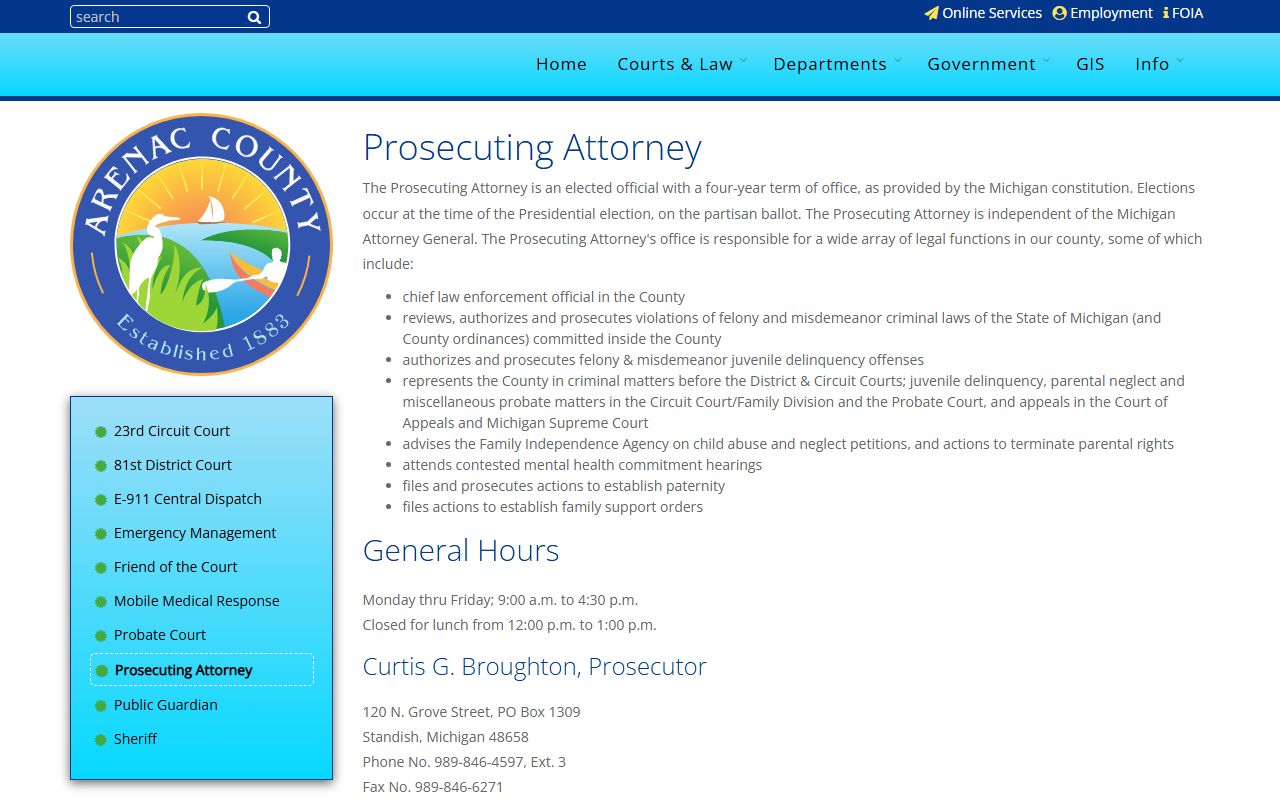
The prosecutor, not the arresting officer, holds the charging decision for most cases that move forward. That page also lists the assistant prosecutor and the crime victim advocate. The table below sorts the three charging documents by who files them and the offenses they usually cover.
| Complaint | Information | Indictment | |
|---|---|---|---|
| Filed By | Officer / Prosecutor | Prosecutor | Grand Jury |
| Common For | Misdemeanors | Many felonies | Serious felonies |
| Starts | The case | The case | The case |
Most Michigan felony cases move by complaint and then information after a preliminary exam. The grand jury indictment path is far less common at the county level. Note: the charging document sets the counts, but a judge or plea can change them as the case moves.
Charge Status in Arenac County Cases
Charges rarely stay frozen. As a case moves through the 81st District Court or the 23rd Circuit Court, counts can be amended, reduced, added, dropped, or dismissed. The status field in the court record shows where each charge stands. Reading it correctly keeps you from mistaking an early filing for a final result. A charge marked pending is still open. A charge marked dismissed is closed without a conviction on that count.
| Status | What It Means |
|---|---|
| Pending | The charge is filed and active, and the case has not yet reached a verdict or plea. |
| Amended / Reduced | The prosecutor changed the charge, often to a lesser offense or a different statute. |
| Dismissed | The court or prosecutor ended the charge before any conviction was entered. |
| Nolle Prosequi | The prosecutor formally declined to pursue the charge, dropping it from the case. |
One case can hold several charges at once, each with its own status. A defendant might plead to one count while the prosecutor drops two others. The record shows every count and its result. That is why the full case file matters. The Arenac County criminal court records page walks through the whole case, from arraignment to sentence.
Charges vs. Convictions
A charge is not a conviction. Being charged means the state has accused a person of a crime and filed the counts in court. A conviction means the case ended in a guilty plea or a guilty verdict. The gap between the two is large, and the record keeps them separate. Many charges never become convictions. They get reduced, dropped, or dismissed along the way.
| Charge | Conviction | |
|---|---|---|
| Stage | Accusation | Verdict or plea |
| Burden of Proof | Probable cause | Beyond reasonable doubt |
| Public Record | Yes | Yes |
Both charges and convictions are generally public in Michigan. The difference is what they prove. A charge shows an accusation backed by probable cause. A conviction shows the state met the far higher bar of proof beyond a reasonable doubt. Reading the status field on each count is the only reliable way to tell them apart.
Sealed vs. Expunged Records
Some charge records leave the public view entirely. Michigan gives two main paths, and they are not the same. A sealed record is hidden from ordinary public access but still exists. An expunged, or set-aside, record is treated as though the conviction never happened. Michigan's set-aside statute, MCL 780.621, controls the expungement path and sets firm limits on who qualifies.
| Sealed | Expunged | |
|---|---|---|
| Visibility | Hidden from public | Destroyed / treated as never existed |
| Law Enforcement | Limited access | Very limited |
| Eligibility | Set by court rule or court order | Set-aside under MCL 780.621, with offense and waiting limits |
An expungement in Michigan runs through the court that entered the conviction. The applicant confirms the conviction qualifies, files with the convicting court, and clears a waiting period before a hearing. Not every offense qualifies, and the statute caps how many convictions a person can set aside. Once granted, later public lookups should reflect the set-aside status.
Arenac County Charge Codes and Severity
Every charge ties back to a statute. The court record lists the code so the count can be matched to the exact Michigan law it rests on. That code also carries the severity level. Michigan sorts offenses into felonies, misdemeanors, and civil infractions, and the level shapes which court hears the case and what penalties apply.
Felonies carry the heaviest exposure and route to the circuit court after a district court arraignment and preliminary exam. Misdemeanors stay in the district court. Civil infractions, such as most traffic tickets, are not crimes at all and produce fines rather than jail. One arrest can generate several separate charges at different levels. A single incident might list a felony count, a misdemeanor count, and an infraction, each coded and tracked on its own line in the record.
Statewide Charge and Criminal History Lookups
Charges filed in Arenac County roll up into the statewide court system. The Michigan Courts case search is the public front door for case-level charge data, and it reaches every trial court, not just Standish. A name search there can surface cases filed in other Michigan counties, which helps when a person has moved or was charged elsewhere.
State-supervised offenders sit in a different system. The Michigan Offender Tracking Information System, known as OTIS, lists prisoners, parolees, and probationers under state supervision, plus people discharged within the past three years. OTIS is not a charge database and not a county jail roster, so it fills a narrow role. For court charges themselves, the case search remains the primary statewide tool.
Note: OTIS drops records beyond the three-year discharge window and leaves out information that Michigan law exempts from release.
Background Checks and Arrest Records
A casual name search is not the same as a formal background check. Employers, landlords, and licensing bodies that rely on criminal history must follow the federal Fair Credit Reporting Act and use a screening firm built for that purpose. A quick court case-search lookup is fine for personal knowledge, but it carries no legal certification and can miss sealed or corrected records.
Certified charge records for a legal proceeding come from the court clerk, not from a web search. When the record has to stand up in court or before an agency, request a certified copy through the court counter in Standish.
Important: This site is not a consumer reporting agency under the Fair Credit Reporting Act, and its records must not drive hiring, housing, or credit decisions.
When Arenac County Charges Are Not Online
Not every charge or arrest detail shows up in a public database. Arenac County does not run a public warrant list or a public jail booking search, so some early-stage records need a phone call or a request. When the online case search comes up empty, a short fallback chain usually finds the answer.
- Call the Arenac County Sheriff's Office at 989-846-3002 for custody and arrest questions.
- File a public-records request with the county FOIA coordinator, the Arenac County Clerk, for releasable records.
- Visit the court counter at 120 N. Grove Street in Standish for older or off-line case files.
- Ask the prosecutor's office about the status of a filed charge.
Michigan's public-records law gives the county five business days to answer a FOIA request, with a possible ten-day extension. That path covers county records that are not court files. Court charge records themselves are governed by the court rules and are usually easiest to reach through the case search or the clerk of the court.
Restricted Charge Records in Arenac County
Not all charge records are open to the general public. Michigan law walls off several categories even when the rest of a docket is public. Juvenile charges are the clearest example. Under MCL 712A.28, juvenile case records are open only to people with a legitimate interest, so they do not appear in an ordinary public search.
Sealed and set-aside charges also leave the public view once a court grants the order. Ongoing investigations can stay out of reach while a case is still being built, and Michigan's FOIA exemptions cover certain law-enforcement and personal-data records. A dismissed charge may still show on the case record unless it has been set aside, so a clean-looking name in one system does not guarantee a clean record everywhere. When a record seems missing, restriction is often the reason rather than error.