
Criminal Court Records in Arenac County
A criminal court record opens the moment a case is filed, not when an arrest happens. The court clerk creates the file, assigns a case number, and logs every step that follows. That log is the docket. It lists each charge, each hearing, each motion, and the judge who signed each order. The file grows as the case moves, and it closes with a disposition and, where there is a conviction, a sentence. The clerk holds the paper file and the electronic entries for the court that heard the matter.
Two trial courts produce criminal records in Arenac County, and both sit inside the same complex at 120 N. Grove Street in Standish. The 81st District Court handles misdemeanors, and it also takes felony arraignments and preliminary exams before a felony moves up. The 23rd Circuit Court handles felonies and serious misdemeanors, and it covers Alcona, Arenac, Iosco, and Oscoda counties with one circuit judge. Chief Judge Richard E. Vollbach, Jr. and Judge David C. Riffel sit on the circuit bench. A single misdemeanor may live entirely in the district court, while a felony often has entries in both courts.
How to Search Arenac County Criminal Court Records
The main online path is the state system. Michigan Courts runs a public case search for cases, opinions, and orders, and the county courts feed their dockets into that system. You can start with a case number or search by a party name, then narrow by the court level. The public view shows case number, party names, and case history, which is the baseline the court rules allow online.
- Open the Michigan Courts case search and pick the public search path.
- Enter the defendant name, or type the case number if you already have it.
- Filter by lower court or appellate court to focus on the 81st District or 23rd Circuit.
- Open the matching case to read the docket, the charges, and the disposition.
- Request a certified copy from the clerk when you need the record for legal use.
Not every file sits online. Older cases, sealed matters, and full paper files often stay at the courthouse counter. For those, the clerk in Standish remains the fallback, and staff can pull a case, confirm a disposition, or issue a certified copy for a fee. The county clerk also serves as clerk of the circuit court, so felony judgments and orders trace back to that office.
Stages of an Arenac County Criminal Case
A criminal case moves through set stages, and each one leaves a mark in the record. The docket reads like a timeline, so a reader can follow the case from the charging document to the last order. A felony passes through the district court for its early steps, then moves to the circuit court for trial and sentencing. A misdemeanor usually stays in the district court from start to finish.
Case flow: Charges Filed › Arraignment › Pretrial or Preliminary Exam › Plea or Trial › Disposition › Sentencing
| Stage | What Happens |
|---|---|
| Charges Filed | The prosecutor files a complaint that names the defendant and lists each charge. |
| Arraignment | The court reads the charges, sets bond, and the defendant enters a first plea. |
| Pretrial or Preliminary Exam | Motions get heard, and a felony faces an exam that tests whether the case moves up. |
| Plea or Trial | The case ends in a plea deal or goes to a bench or jury trial. |
| Sentencing | After a conviction the judge orders jail, probation, fines, or other terms. |
Note: A preliminary exam is the felony gate, and a defendant may waive it, which the docket will show as a waived exam.
What an Arenac County Criminal Court Record Shows
The file is built from fields, and each field answers one question about the case. Michigan's records rules keep the public online view to case number, party names, and case history, yet the full court file at the counter carries far more. Reading the record field by field is the fastest way to understand what a case did and how it ended. The chapter 8 court rules set out how these files are kept and released.
The Michigan Court Rules are published in full, and chapter 8 covers court administration and public access to case records. The rule that governs the court file, MCR 8.119, sits in that chapter.
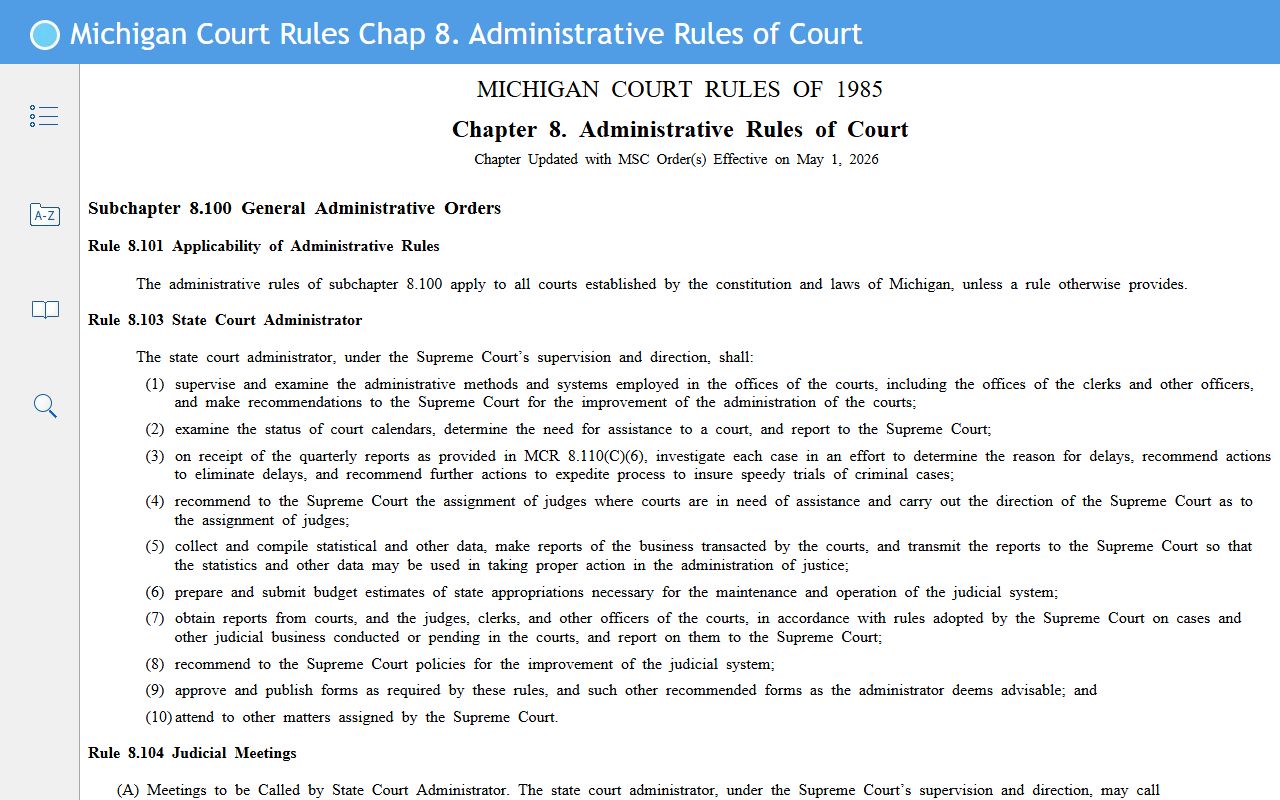
That chapter tells the clerk how to keep a case file open to the public while shielding the parts the law protects. The table below breaks down the fields a reader will meet in an Arenac County criminal file.
| Field | What It Shows |
|---|---|
| Case Number | The unique code the clerk assigns, tied to the court and filing year. |
| Defendant | The person charged, listed with the court and county of record. |
| Charges | Each count as filed, with the statute and the severity level. |
| Judge | The judge assigned to hear and rule on the case. |
| Plea | How the defendant answered each charge at arraignment or later. |
| Disposition | The final outcome for each count, from dismissed to convicted. |
| Sentence | The terms ordered after a conviction, such as jail, fines, or probation. |
Charges vs. Convictions
A charge is an accusation, and a conviction is a proven result. A criminal court record can list charges that were later dropped, dismissed, or that ended in an acquittal. Reading only the charge line can mislead, since the case may have closed with no finding of guilt. The disposition line, not the charge line, tells the true outcome. For a closer look at how charges are filed and how their status changes, the Arenac County court charge records break down the charging side in detail.
| Charge | Conviction | |
|---|---|---|
| Stage | Accusation at filing | Verdict or accepted plea |
| Burden of Proof | Probable cause | Beyond a reasonable doubt |
| Can Be Dropped | Yes, before trial | Only through appeal or set-aside |
| Public Record | Yes | Yes |
Reading Dispositions and Sentences
The disposition is the case outcome, and it appears on the docket in short terms. A guilty plea, a jury verdict, a dismissal, and an acquittal each read as a disposition. Some counts end with a plea to a lesser charge, and the record will show the original count and the reduced one. Where a case is deferred, the docket may show a hold that clears once the defendant meets set terms.
The sentence follows a conviction, and it spells out the penalty. In Arenac County a district court sentence often mixes fines, costs, and probation, while a circuit court felony sentence can add jail or a state prison term. The record lists each part of the sentence, the length, and any conditions the judge sets. Fines, costs, and bond entries also sit in the file, since payment data is part of the case history. A reader who wants the full order, not just the docket summary, can request the signed judgment from the clerk.
The Prosecutor's Charging Role
Charges do not start with the court. The Arenac County Prosecuting Attorney reviews the police work and decides what to file. Curtis G. Broughton serves as the county prosecutor and acts as the chief law enforcement official in the county. His office prosecutes felony and misdemeanor cases, county ordinance violations, and juvenile delinquency matters, and it represents the county on appeals. The charging choice sets the whole record in motion, since the complaint the office files becomes the first entry in the case.
The office works out of the court complex and can confirm whether a matter has been charged. Its role runs from the first filing through the plea or trial and into any appeal.
Arenac County Prosecuting Attorney
Curtis G. Broughton
120 N. Grove Street, P.O. Box 1309
Standish, MI 48658
989-846-4597 ext. 3 (fax 989-846-6271)
Mon to Fri, 9:00 a.m. to 4:30 p.m., closed noon to 1:00 p.m.
Public Access to Criminal Court Records
Criminal case files are generally open, but the court rules control the access, not a blanket records law. Michigan treats court records under its own rules, so the clerk follows the Michigan Court Rules first and the Freedom of Information Act second. That split matters, since a court file may be public while a related agency record stays exempt. The general rule is openness, with named limits for juvenile, sealed, and personal data.
Key rules and statutes:
MCR 8.119 keeps court case records open to the public, subject to set limits and sealing rules.
MCL 15.243 lists the FOIA exemptions that let an agency withhold personal and certain law enforcement records.
For records that are not court files, the county route runs through the county clerk, who serves as the FOIA coordinator. The county has five business days to answer a request, with a possible ten-day extension. Court files themselves, though, come from the court clerk under the court rules. All of these criminal files are one part of the wider Arenac County court records system across the Standish complex.
Sealed vs. Expunged Records
Sealing and expungement both restrict a record, but they are not the same act. A sealed record is hidden from ordinary public view while it still exists in the system. An expunged, or set-aside, conviction is treated as though it never happened for most purposes. Michigan uses the set-aside process for convictions, and it runs through the court that entered the conviction.
| Sealed | Expunged / Set Aside | |
|---|---|---|
| Visibility | Hidden from public view | Treated as never having occurred |
| Law Enforcement | Limited access remains | Very limited access |
| How It Happens | Court order under the rules | Application to the convicting court |
| Eligibility | Set by court rule and statute | Limited by MCL 780.621 offense and count caps |
The set-aside statute is published in full, and readers can review MCL 780.621 on setting aside a conviction before they apply. The law limits how many convictions and what kinds of offenses can be cleared.
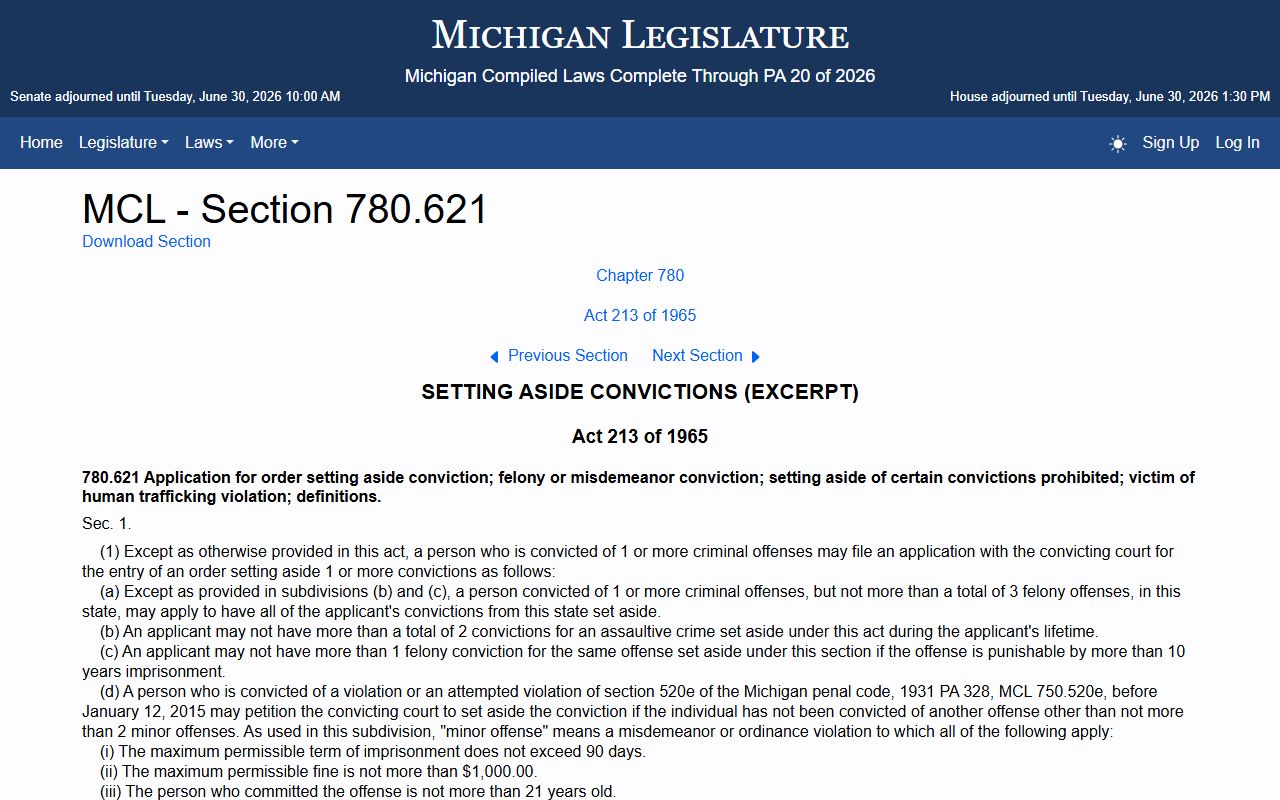
The practical set-aside path in Arenac County follows a set order once a person confirms the conviction qualifies.
- Confirm the conviction qualifies under the offense and count caps.
- File the set-aside application with the convicting court in Standish.
- Check the waiting period, which runs from the sentence or release.
- Expect notice to the prosecutor and a court hearing on the request.
- If the judge grants it, the conviction is set aside and public lookups should reflect that.
Restricted Criminal Court Records in Arenac County
Not every criminal matter is open to the public. Juvenile cases carry the tightest limits, and sealed or set-aside files drop out of the public view once a court orders it. Personal data inside an otherwise public file can also be redacted before release. When a search returns nothing, a restriction may be the reason, not a gap in the record.
Juvenile delinquency files are the clearest example. Michigan law opens juvenile case records only to people with a legitimate interest, so they do not sit in the general public view the way an adult docket does. The statute is published for readers who need the detail, and it sets who may see a juvenile file.
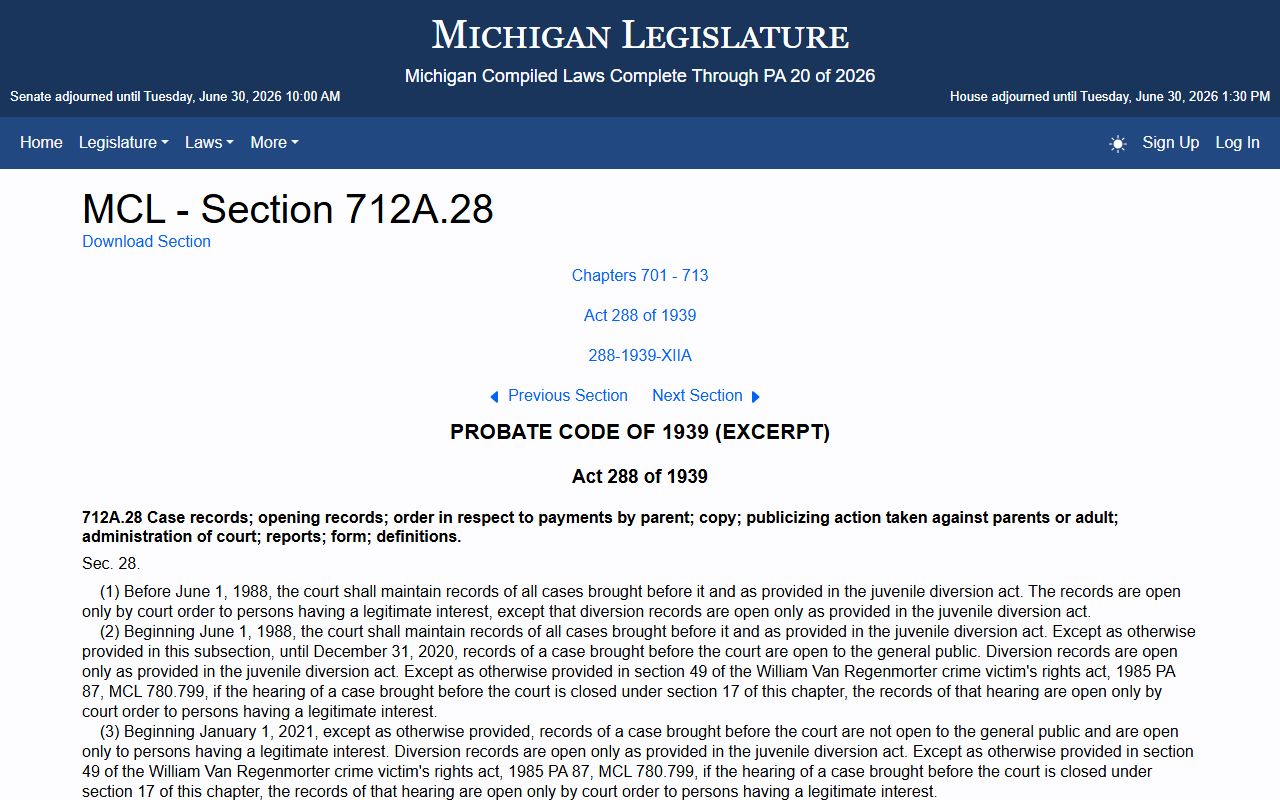
Readers can review MCL 712A.28 on juvenile case records to see the access limits in full. Between the juvenile rules, the set-aside statute, and the court file rules, the county holds a clear line on what a public criminal search may and may not return.