
What a Court Docket Is
A docket is the dated log of court events and filings in a single case. Some courts call it the register of actions. Each line marks one thing that happened, such as a complaint filed, a motion set, a hearing held, or an order signed. Read top to bottom, the docket becomes a timeline of the case. It does not hold the documents themselves. It points to them and shows when each one landed with the court.
In Arenac County the docket is a public window into the 23rd Circuit Court, the 81st District Court, and the Probate Court. Michigan runs its trial courts as one court of justice, so the docket format is consistent across all three. A reader who learns to scan one docket can read them all. The terms below appear on nearly every Arenac County docket and case history.
- Docket
- The dated log of court events and filings in a case.
- Case history
- The same event list, often labeled this way inside the state case-search view.
- Party
- A person or business named in the case, such as a plaintiff, defendant, petitioner, or respondent.
- Disposition
- The final outcome or ruling once the case closes.
- Hearing
- A scheduled court date with a time, a courtroom, and a judge.
The docket differs from the full case file in scope. The file holds the actual motions, exhibits, orders, and judgments. The docket is the index to that file. For quick tracking the docket is usually enough, and for legal review the full file is the right source.
How to Find Arenac County Dockets Online
Michigan's statewide case-search system is the main online path to a docket. The public entry point lets you look up case information, court documents, orders, and opinions across the trial courts. Because the state runs one search layer, a single lookup can reach circuit, district, and probate cases in Standish. You can start with a case number when you have one, or search by party name and filter by court.
The 81st District Court publishes a ticket-cost and case lookup that opens the district court's space inside the state system. It is the quickest route to a traffic or misdemeanor docket. The link and screen below come from the official 81st District Court ticket lookup in MiCOURT.
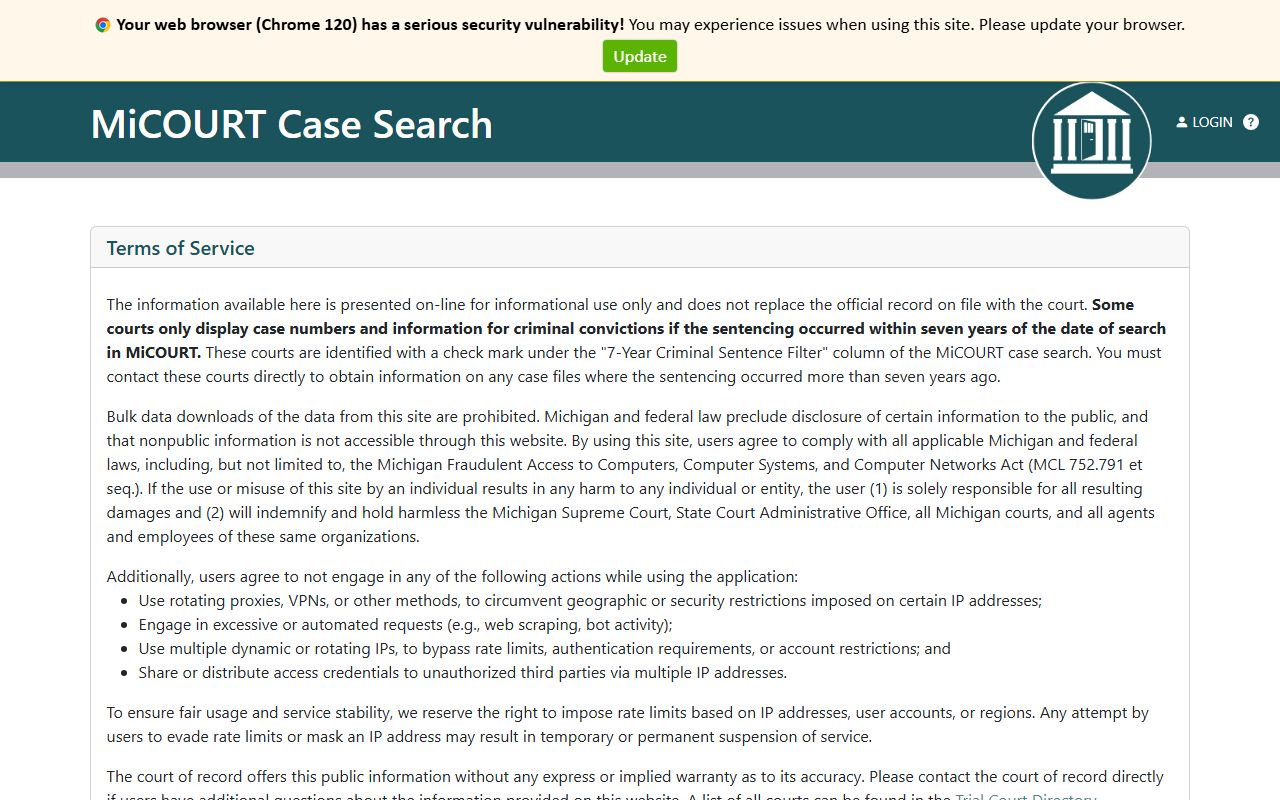
That screen confirms how a district docket is pulled by ticket or case detail rather than a broad name sweep. The steps below mirror how most Arenac County docket lookups run from start to finish.
- Open the Michigan Courts case-search page for cases, opinions, and orders.
- Enter a case number if you already have it.
- Switch to party name when you do not, then narrow by the lower court or the court level.
- Open the matching result to reach the case history and docket.
- Read the entries top to bottom for the next hearing date and the assigned judge.
Note: The state system separates a public case-search view from a secured login path, so some detailed views require a court-issued account.
What an Arenac County Docket Shows
Each docket entry is short, but it packs several fields into one line. Once a hearing is scheduled, the entry adds the date, the time, and the courtroom. Party names and the case number stay fixed across every line, and the judge's name follows the case. The public view on a court website is meant to show the case number, the party names, and the case history at minimum, with more detail visible on the court's own screens.
The table below breaks a sample docket entry into its parts and explains what each field tells you.
| Field | What It Shows |
|---|---|
| Case Number | The court's unique identifier for the case, fixed across every entry. |
| Party Names | The plaintiff and defendant, or petitioner and respondent, tied to the case. |
| Entry Date | The date the event or filing was logged with the court. |
| Event Type | The action recorded, such as a filing, a motion, a hearing, or an order. |
| Hearing Date and Time | The scheduled court date and clock time for the next appearance. |
| Courtroom | The room or judge assignment for the hearing at the Standish complex. |
| Judge | The judge assigned to the case, often Judge Vollbach or Judge Riffel here. |
| Status or Disposition | Whether the case is open, adjourned, or closed with an outcome. |
Not every field appears on every line. A filing entry may show only the date and the document type, while a hearing entry adds the time and the courtroom. Fees, fines, and bond figures show up on payment-related entries. Attorney and bar-number data appear where a lawyer has filed an appearance.
Courts That Publish Dockets Here
All three Arenac County trial courts sit in the same complex at 120 N. Grove Street, and each links to at least one public docket or calendar tool. The circuit and probate courts post docket displays through the state system, while the district court posts its ticket and case lookup. The routing below shows which court holds which docket.
- 81st District Court: traffic infractions, misdemeanors, small civil claims, garnishments, evictions, and felony arraignments.
- 23rd Circuit Court: felonies, civil cases over $25,000, divorce and family matters, and child protective cases.
- Probate Court: estates, wills, adult guardianships, conservatorships, and mental-health commitments.
The Probate Court links a court docket display that lists scheduled matters for public viewing. The screen below is the official Probate Court docket display for Arenac County.
That display shows how a probate calendar is published as a rolling list of set matters rather than a searchable database. For a deeper look at each court's role and contacts, the Arenac County circuit court page breaks down the trial-court structure in Standish.
Docket Versus the Full Case File
People often ask for a docket when they really want the file, or the reverse. The two serve different jobs. A docket is a list of events, quick to scan and often free to view online. The full case file holds the signed documents, the exhibits, and the orders, and it may require a fee or a trip to the courthouse counter. Knowing which one you need saves a wasted request.
The comparison below lines up the two side by side.
| Docket | Full Case File | |
|---|---|---|
| Format | List of dated entries | Full documents and exhibits |
| Access | Often online and free to view | May require a fee or a counter visit |
| Best Use | Track case progress and hearings | Legal review, evidence, certified copies |
| Source | State case search and court displays | Court clerk at 120 N. Grove Street |
For most needs the docket answers the question. If a court date, a judge, or a case status is all you want, the online entry does the job. When you need a certified order for another agency or a full record for a lawyer, the file is the right source, and the clerk's counter is where you go for it.
Court-Level Docket Differences
The court level changes what a docket covers and how you reach it. The 81st District Court handles the high-volume, lower-stakes matters, so its dockets fill with traffic tickets, misdemeanors, and small civil claims. Its lookup is built around a ticket or case detail, which fits how most people arrive with a citation number in hand. A district docket moves fast and often closes in a single hearing.
The 23rd Circuit Court sits a level up and carries the heavier files. It covers Alcona, Arenac, Iosco, and Oscoda counties with one circuit judge, and it hears felonies, larger civil disputes, divorces, and child protective cases. A circuit docket tends to run longer, with more motions, more hearings, and a clearer path to disposition. Its docket display is published for public viewing rather than searched by ticket.
The Probate Court handles estates, guardianships, conservatorships, and mental-health matters. Its docket reads as a calendar of set hearings, and some of its matters carry tighter privacy limits than a routine civil case. Judge Vollbach serves across the probate, family, district, and circuit dockets, so the same name appears on files from very different court levels.
Note: A felony often starts in district court for the arraignment and preliminary exam, then moves to circuit court, so its docket trail can span two courts.
Pulling Older Arenac County Dockets
Not every case lives online. Older files, sealed matters, and records that predate the current system may not appear in a public search. When the state system comes up short, the courthouse counter in Standish remains the reliable fallback. County offices still handle older and off-line files, and staff can pull a physical docket or point you to the right court division.
The County Clerk also serves as clerk of the Circuit Court and as the county FOIA coordinator, which makes that office a useful starting point for certified copies and public-record requests. For a case the online search will not surface, a call or a visit to the clerk sets the process in motion. The contact block below covers the office that handles those requests.
120 N. Grove Street, P.O. Box 747
Standish, MI 48658
Phone: 989-846-4626
Fax: 989-846-9194
Hours: Monday to Friday, 9:00 a.m. to 4:30 p.m.
Bring as much detail as you can when you request an older docket. A name, an approximate filing year, and a case type help staff find the file quickly. For a full walk through the search tools and record types, the Arenac County court records guide covers the same state system in more depth.
Open Cases and Court Calendars
A docket lookup and a court calendar answer two related questions. The docket tells you what has happened in one case. The calendar tells you what is scheduled across the court on a given day. The circuit and probate docket displays lean toward the calendar view, listing set matters that the public can watch. The district court lookup leans toward the single case, built around a ticket or case number.
Court hours matter when you plan a visit or a call. The district and probate offices run Monday through Friday, 8:30 a.m. to 4:30 p.m., with a lunch break from noon to 1:00 p.m. Filing a document, paying a fine, or asking about a set hearing all fit inside those hours. The online displays stay available around the clock for reading, while staff help is tied to the counter schedule.
Open-cases filters help when a name returns many results. Limiting a search to open cases trims closed and archived files and surfaces the active docket faster. That filter pairs well with a court-level filter when a common surname pulls a long list from more than one court.